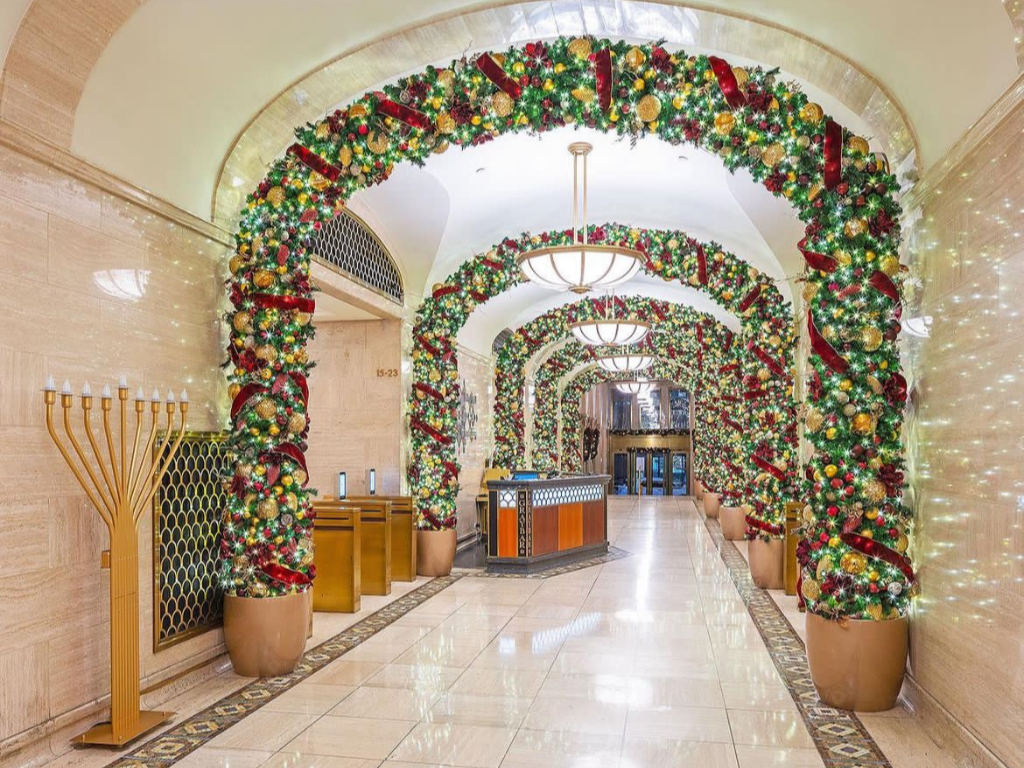
Commercial holiday lighting is a temporary installation operating in a permanent, active property. Successful programs pair a strong visual concept with early technical planning so crews can install safely, power the display reliably, and protect normal building operations.
Seven planning essentials
How to plan professional holiday light installation
- 01
Survey the property and define the lighting scope
A site walk identifies rooflines, entrances, trees, columns, canopies, windows, interior focal points, public circulation, and the best viewing angles. The final scope should distinguish decorative priorities from areas that must remain clear for operations and emergency access.
- 02
Complete electrical load planning
Professional holiday light installation starts with available circuits, outlet locations, fixture wattage, cable paths, timers, controls, and weather-rated connections. Load planning helps prevent nuisance trips and keeps temporary power from interfering with building systems.
- 03
Coordinate lifts and facade access
Facade, canopy, tree, and roofline installations may require boom lifts, scissor lifts, ladders, rigging, loading-zone access, or sidewalk protection. NYC properties should confirm delivery windows, staging areas, operator requirements, and any building or street restrictions before installation day.
- 04
Specify commercial-grade outdoor equipment
Exterior displays need weather-rated lights, connectors, controllers, attachment hardware, and cable management selected for wind, moisture, temperature swings, and repeated seasonal use. Materials should be scaled for the viewing distance and the architecture.
- 05
Protect safety and public circulation
Cable routes, attachment points, lift work, and freestanding features must preserve accessible paths, exits, fire equipment, security sightlines, and entrances. Property rules, insurance documentation, trained crews, and applicable safety certifications should be reviewed before work begins.
- 06
Schedule around tenants, guests, and customers
Commercial Christmas light installation often works best during approved loading, overnight, or low-traffic windows. A clear sequence for deliveries, noisy work, lift movement, testing, and final aiming minimizes disruption to active offices, hotels, retail properties, and residential buildings.
- 07
Plan maintenance, removal, and storage
Document timers, controls, spare components, service contacts, takedown dates, packing methods, and storage requirements before launch. This makes in-season service faster and protects the investment for a more consistent display next year.
Local operating conditions
NYC holiday lighting logistics
New York projects often combine limited curb access, freight-elevator reservations, certificate-of-insurance requirements, dense pedestrian traffic, restricted work hours, and multiple property stakeholders. A professional lighting plan should assign responsibility for access approvals, electrical review, lift staging, protection, testing, and final sign-off well before the seasonal deadline.
Plan your commercial Christmas light installation
Cambridge provides site-specific design, commercial-grade lighting, coordinated installation, seasonal removal, and optional storage for offices, hotels, retail, residential properties, shopping centers, and outdoor commercial spaces.